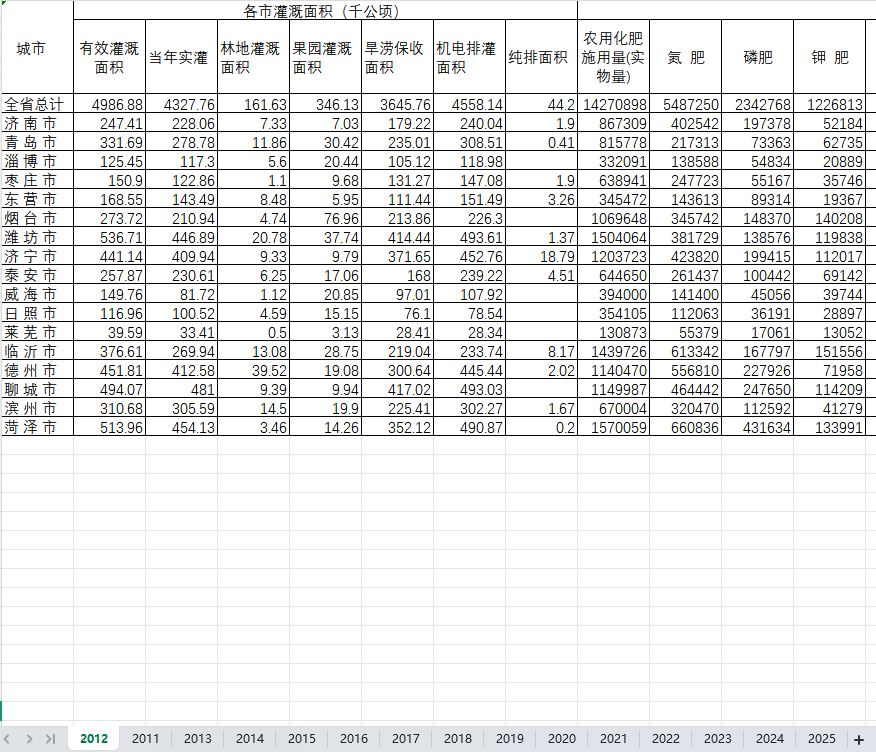
一是数据缺口:缺少部分社会经济与自然地理数据,如各市GDP、非农从业人口、财政支农支出、农业机械总动力、降水量、积温等,这些是构建完整“影响因素指标体系”和深化面板回归模型分析的关键。解决方法:查阅对应年份的《山东省统计年鉴》、《中国县域统计年鉴》、各市统计年鉴及气象局公开数据,进行补充与核实。
二是实践认知:缺少对研究区域农业发展现状的实地调研。解决方法:在研究中期,选取典型县域(如德州、济宁)开展线上问卷或线下访谈,补充一手信息,增强研究的现实针对性。
参考文献
[1] Han S ,Zhang Z ,Han J , et al.Drought impacts on global crop production decline despite its frequency and severity intensifying[J].Environmental Research Letters,2026,21(3):034029-034029.
[2] Rudra R R ,Rabbi F ,Hossain I U N , et al.Unraveling the climate induced drought impacts on crop pattern distribution using explainable machine learning algorithms[J].Environmental Development,2026,58101397-101397.
[3] Zhao Y ,Xiao D .Effect of future climate change and adjusting the sowing date on wheat production in the North China plain[J].Theoretical and Applied Climatology,2026,157(3):166-166.
[4] Kassa A ,Akachukwu D ,Kadege L E , et al.Climate change impacts and adaptations in Eastern and Western Africa crop production systems: lessons and transferable models among smallholder farmers[J].Climate Services,2026,42100644-100644.
[5] Ahsan F ,Nageen F ,Haseeb A , et al.A Critical Review of Climate Change Impact at a Global Scale on Cereal Crop Production[J].Agronomy,2023,13(1):162-162.
[6] Wang X H ,Christoph M ,Joshua E , et al.Global irrigation contribution to wheat and maize yield[J].Nature Communications,2021,12(1):1235-1235.
[7] Zaveri E ,David L B .The role of irrigation in changing wheat yields and heat sensitivity in India.[J].Nature communications, 2019,10(1):4144.
[8] Li L H ,Pingshan J ,Wenfeng L , et al.Increasing Spatial Mismatch of Cropland-Grain Production-Population in China over the Past Two Decades[J].Land,2022,11(10):1685-1685.
[9] Su Z. The Surface Energy Balance System (SEBS) for estimation of turbulent heat fluxes[J]. Hydrology and Earth System Sciences, 2002, 6(1): 85-100.
[10] Ren P P, Huang F, Li B G. Spatiotemporal patterns of water consumption and irrigation requirements of wheat-maize in the Huang-Huai-Hai Plain, China and options of their reduction[J]. Agricultural Water Management, 2022, 263: 107468.
[11] Emami F, Koch M. Agricultural water productivity-based hydro-economic modeling for optimal crop pattern and water resources planning in the Zarrine River Basin, Iran, in the wake of climate change[J]. Sustainability, 2018, 10(11): 3953.
[12] Navid S ,Jahansouz M ,Soufizadeh S .The efficiency of the APSIM model in estimating yield and yield gaps in winter wheat and barley[J].Agronomy Journal,2026,118(1):e70280-e70280.DOI:10.1002/AGJ2.70280.
[13] 刘玉,高秉博,潘瑜春,等. 基于LMDI模型的黄淮海地区县域粮食生产影响因素分解[J]. 农业工程学报,2013,29(21):1-10.
[14] 任频频,李保国,黄峰. 农作物种植结构演变下的黄淮海旱作区小麦玉米生产时空格局[J]. 资源科学,2022,44(3):436-449.
[15] 王晨,张文博,王济民. 我国粮食供给时空变迁及产能提升路径分析[J]. 中国农业资源与区划,2024,45(9):29-41.
[16] 常晓东,王士君,杨志鹏,等. 21世纪以来中国粮食生产能力空间重构过程与驱动机制[J]. 自然资源学报,2025,40(3):728-749.
[17] 武术兰,任频频,侯术海,等. 鲁西平原冬小麦水分生产力时空格局及其变化分解[J]. 中国农学通报,2024,40(23):7-15.
[18] 许静,陈根,徐巧伟. 中国粮食主产区粮食安全韧性“三链”协同时空分异及其驱动因素[J]. 中国生态农业学报(中英文),2026,34(2):448-460.
[19] 于元赫,王越,宫大卫. 山东省粮食生产效率时空演变及影响因素研究[J]. 农业资源与环境学报,2023,40(3):728-738.
[20] 常媛媛,刘俊娜,张琦,等. 粮食主产区耕地非粮化空间格局分异及其成因[J]. 农业资源与环境学报,2022,39(4):817-826.
[21] 耿庆玲,宗婷娟,曹源源,等.黄河流域水-粮-碳关联耦合的时空演变特征[J/OL].生态学报,2026,(11):1-15[2026-03-17].
[22] 井淼,张江江,刘瑾,等.水位、水量、产量联控的华北平原地下水超采区节水灌溉多目标优化[J].水资源保护,2025,41(02):184-192.