5. 双金属铂基纳米材料在生物传感器中的应用
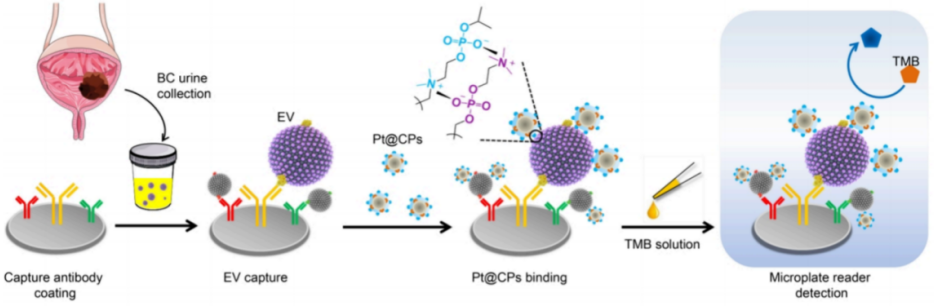
双金属铂基纳米材料因其独特的高电化学活性与极高的灵敏度,常应用于生物传感器研发。Xiao 等人系统综述了双金属金-铂(AuPt)纳米酶在食品安全监测中的应用,指出AuPt纳米酶在催化性能上优于单金属及其他基于金的双金属杂交酶,这是由于其比色、催化、几何和集合等协同特性。该综述涵盖了种子介导生长和不同还原剂的单锅合成方法,以及比色法、电化学和多模态传感等检测模式[16]。Kalkal 等人研究了金属有机框架/埃洛石纳米复合材料在生物医学中的应用,制备了HNTs@ZIF-8用于抗肿瘤治疗,为铂基纳米材料的载体设计提供了新思路[17]。Zhai 等人设计了以锌、镁为代表的金属基刺激响应纳米平台,虽然主要关注ZnO纳米材料,但其构建的具有双重响应性能的纳米体系为铂基纳米材料的设计提供了重要参考,特别是在深层组织相关疾病治疗中的智能治疗系统构建方面[18]。
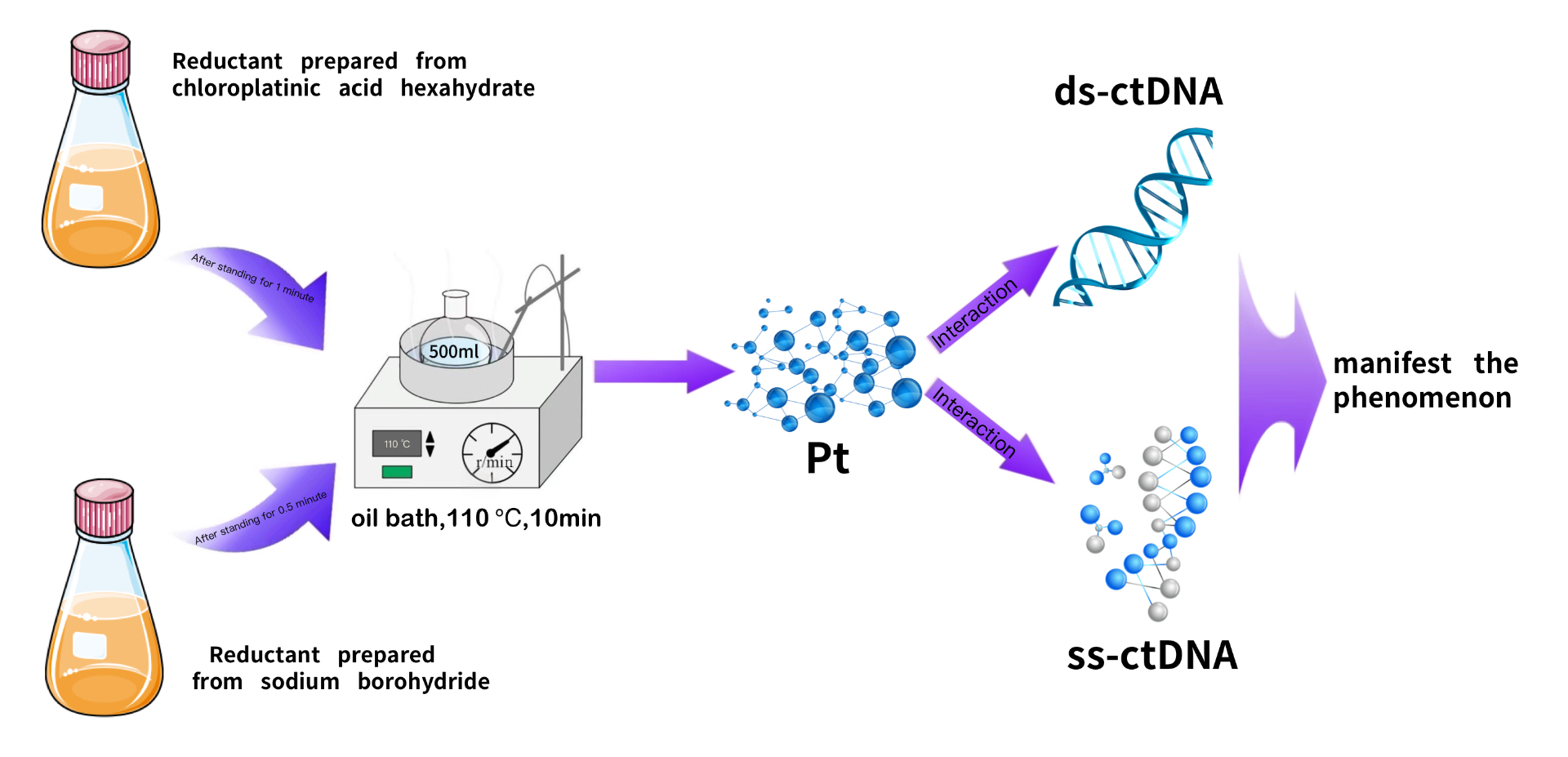
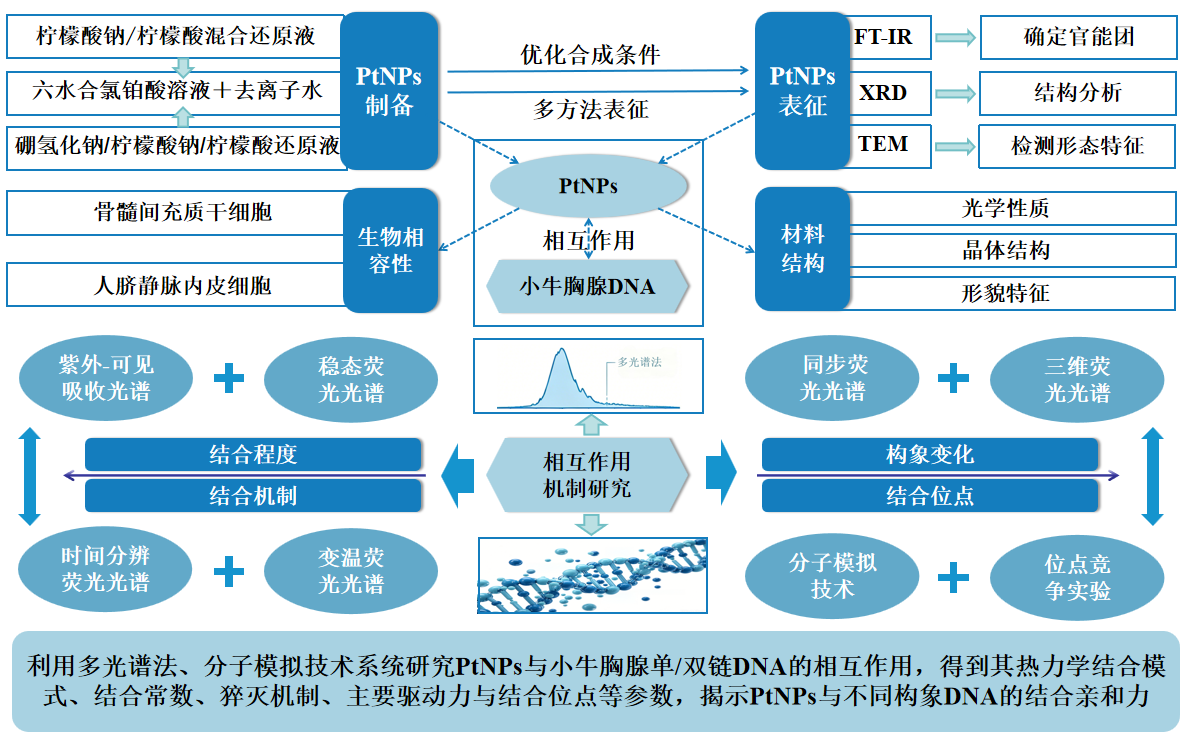
目前,铂纳米颗粒与DNA相互作用的系统研究仍较为薄弱,尤其是在单链与双链DNA结合差异、热力学驱动机制及结合位点等方面缺乏深入探讨。基于此,本项目拟采用多光谱法、等温滴定量热及分子对接模拟等手段,系统阐明PtNPs与不同构象DNA的结合模式与热力学规律,并评估其生物相容性,为铂纳米材料在基因递送、生物传感及纳米安全评估等领域的应用提供理论依据。
参考文献
1. Xu, X.Y., et al., Investigation of the Interaction between Platinum Nanozymes and Serum Albumin by Multispectroscopic Approach and Molecular Docking Simulation. ACS Applied Materials & Interfaces, 2026. 18(5): p. 8670-8684.
2. Xu, X.Y., et al., Binding of single/double stranded ct-DNA with graphene oxide-silver nanocomposites in vitro: A multispectroscopic approach. International Journal of Biological Macromolecules, 2024. 275.
3. Lu J, Li C, Zhang E, et al. Novel Vertical Flow Immunoassay with Au@PtNZs for Rapid, Ultrasensitive, and On-Site Diagnosis of Human Brucellosis. ACS Omega, 2023. 8(32):29534-29542.
4. Wang, C., et al., Flexible free-standing antibacterial nanoporous Ag ribbon. J Colloid Interface Sci, 2023. 645: p. 287-296.
5. Perfézou, M., A. Turner, and A. Merkoçi, Cancer detection using nanoparticle-based sensors. Chem Soc Rev, 2012. 41(7): p. 2606-22.
6. Jia J, Zhu W, Du X, et al. Robust Synthesis of GO-PtNPs Nanocomposites: A Highly Selective Colorimetric Sensor for Mercury Ion (II) Detection. ACS Omega, 2023. 8:46292-46299.
7. Marques, C., et al., Understanding protein-nanoparticle interactions leading to protein corona formation: In vitro - in vivo correlation study. Int J Biol Macromol, 2024. 256(Pt 1): p. 128339.
8. Triviño-Rojas, M.K., et al., Antibacterial Activities and Calf Thymus DNA-Bovine Serum Albumin Interactions of Tridentate NNO Hydrazone Schiff Base-Metal Complexes. Inorganics, 2025. 13(7).
9. Saravanan, T., et al., Explorations on Antioxidant, Enzyme Inhibitory, and Calf Thymus DNA Interaction Studies of Dioxomolybdenum(VI) Organo Complexes. Chemistry & Biodiversity, 2025. 22(8).
10. Shahabadi, N., et al., Interaction studies of water-soluble Zn(II) complex with calf thymus DNA using biophysical and molecular docking methods. Nucleosides Nucleotides & Nucleic Acids, 2024. 43(6): p. 493-516.
11. Rachma, B., M. Savitri, and H. Sutanto, Cardiotoxicity in platinum-based chemotherapy: Mechanisms, manifestations, and management. Cancer Pathogenesis and Therapy, 2025. 3(2): p. 101-108.
12. Pigg, H.C., et al., The unique Pt(II)-induced nucleolar stress response and its deviation from DNA damage response pathways. Journal of Biological Chemistry, 2024. 300(11).
13. Yang, G., et al., Platinum Nanoparticles Loaded Graphitic Carbon Nitride Nanosheets with Enhanced Peroxidase-like Activity for H2O2 and Oxidase-Based Sensing. Molecules, 2023. 28(9).
14. Zhang, S., et al., L-cysteine-modified chiral gold nanoparticles promote periodontal tissue regeneration. Bioact Mater, 2021. 6(10): p. 3288-3299.
15. Ruan, S., et al., Increased Gold Nanoparticle Retention in Brain Tumors by in Situ Enzyme-Induced Aggregation. ACS Nano, 2016. 10(11): p. 10086-10098.
16. Xiao, F., et al., Loop-mediated isothermal amplification coupled with nanoparticle-based lateral flow biosensor for monkeypox virus detection. Talanta, 2024. 269: p. 125502.
17. Kalkal, A., R. Pradhan, and G. Packirisamy, Gold nanoparticles modified reduced graphene oxide nanosheets based dual-quencher for highly sensitive detection of carcinoembryonic antigen. Int J Biol Macromol, 2023. 242(Pt 4): p. 125157.
18. Zhai, X., et al., A nano-composite hyaluronic acid-based hydrogel that is antibacterial and scavenges ROS for promoting infected diabetic wound healing. Carbohydr Polym, 2024. 334: p. 122064.